


Small Bites: Learning geometry with pumpkin pie requires a pumpkin pie, right? Well, here’s a Healthy Pumpkin Pie Recipe from our friend Katie Kimball that you should definitely try. This holiday season, make sure to tune in to this podcast that Katie just did with JoAnn Crohn of No Guilt Mom about Navigating Holiday Stress.
If you’re looking for holiday gift ideas, look no further than Katie’s DIY Christmas Gifts or Non-Toy Christmas Gifts.
This Holiday Season, get 50% off #LifeSkillsNow Mini-Series Ultimate Holiday Skills Bundle (thru Dec. 31st)
✨ Explore the full Kids Cook Real Food eCourse here
🎒 Try a free sample lesson from the Kids Cook Solo series
You can find all of our BONUS Educational Cooking Activities & Holiday Recipes right here!
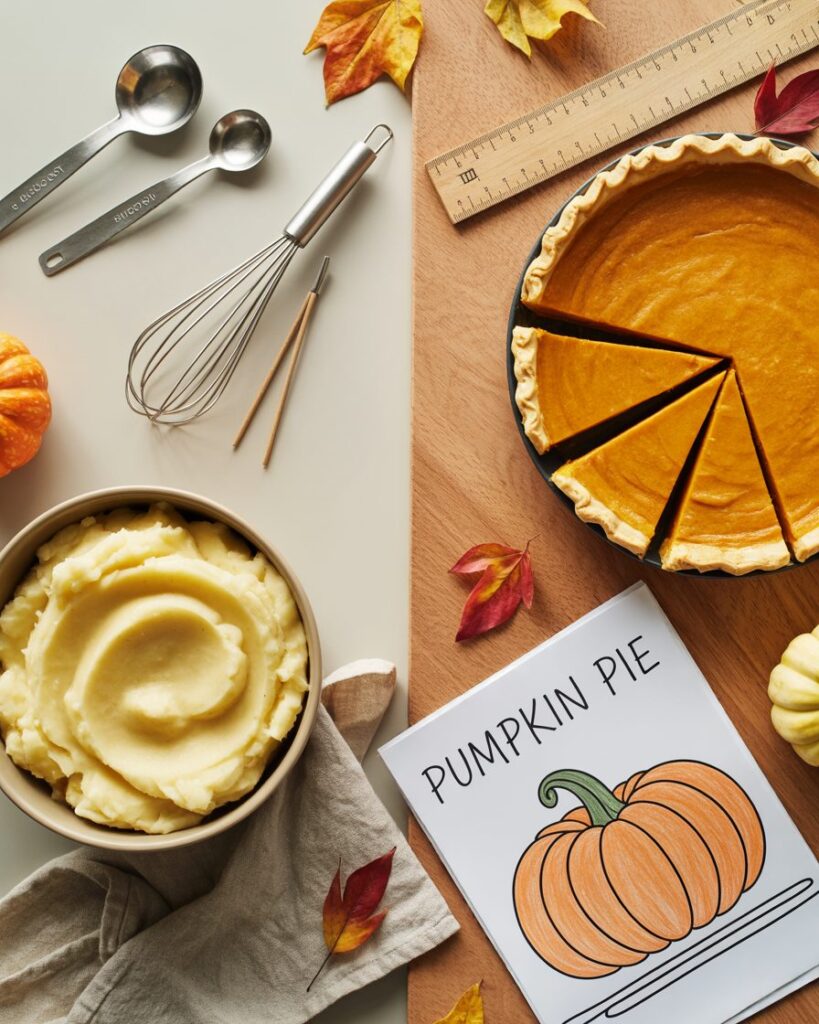
Thanksgiving is the perfect time to bring a little learning to the table — and not just about gratitude! Cooking together offers natural opportunities for kids to explore math, science, and sensory discovery, all while making the foods we love most.
This month, we’re celebrating two Thanksgiving classics — mashed potatoes and pumpkin pie — and turning them into hands-on kitchen lessons. This is a complete Thanksgiving Activity and Lesson! We’ve included a downloadable PDF worksheet.
With our Mashed Potato Mixing Lab, kids can experiment with texture, observe real food science, and see how simple ingredients transform. Then, for a sweet finish, Pumpkin Pie Geometry brings math to life through slicing, sharing, and exploring fractions.
These activities are designed for family learning, perfect for a kitchen counter or holiday break project. They combine cooking, curiosity, and connection (and a bit of delicious reward at the end).
Happy Thanksgiving, from our One Potato Family to yours!
Thanksgiving Kitchen Lab + Math Worksheet
Worksheet includes:
- Observation chart for mashed potato textures
- Descriptive vocabulary bank (smooth, creamy, sticky, etc.)
- Fraction identification exercises with pies
- “Slice and Share” fraction word problems
- Bonus challenge: draw your own pie showing ½, ¼, and ⅛
We recommend reading the whole article for inspiration and planning before getting started!!
🥔 Mashed Potato Mixing Lab: The Science of Smooth
Click the button below for a downloadable PDF worksheet for the Mashed Potato Mixing Lab, and read on to set up the activity:
Tools You’ll Need:
- Cooked potatoes (start with 2–3 medium, peeled and boiled)
- Butter
- Milk or cream
- Salt
- Mixing tools: potato masher, fork, whisk, or electric mixer
- Bowls (1 per test batch)
- Spoon for tasting
- Pencil and worksheet
Age Range:
- Younger learners: younger kids can mash and describe taste and texture. Worksheet Part 1.
- Older learners (Age 6+): older kids can mix and record observations. Worksheet Part 2.
Learning Goals
Discover how different ingredients and mixing methods change potato texture.
- Observe how ingredients affect food texture
- Compare outcomes of different mixing methods
- Understand that starch and fat impact consistency
- Use descriptive vocabulary for texture and taste
- Apply scientific thinking: hypothesize → test → record results
Directions:
- Set the scene:
Place cooked potatoes in separate bowls for each test batch (at least three). Label them A, B, and C. - Create your variables:
Bowl A: Mash plain potatoes — no added ingredients.
Bowl B: Add 1 tablespoon butter and 1 tablespoon milk before mashing.
Bowl C: Use a hand mixer or whisk instead of a masher. - Predict and observe:
Ask:- Which one will be smoothest?
- Which will taste richest?
- Which might get gluey or stretchy?
- Mash and Mix:
Let kids mash each batch and notice how the texture changes. - Taste test and record:
Sample a small spoonful from each bowl. Use the worksheet to describe textures — smooth, fluffy, creamy, sticky, lumpy, stretchy. - Ask Why:
- Why do you think the mixer made the potatoes sticky?
- What happened when we added butter or milk?
- What might happen if we added more butter or milk?
- Clean up and reflect:
Talk about how cooking is like science — changing variables changes results!
Tips & Tricks
- Let kids lead — making predictions and observations helps them take ownership.
- Keep it playful and sensory — tasting, touching, describing.
- Ask open-ended questions (“What do you notice?” “What changed?”).
- Celebrate messy fun!
🧠 Science Connection
Potatoes contain starch, which releases when mashed. The more you mix, the more starch you release — and that can turn fluffy potatoes into gluey ones!
Butter and milk coat starch molecules, helping to create a creamy texture. So, there’s chemistry in every bite of mashed potatoes.
🥧 Pumpkin Pie Geometry: Slice and Share
Click the button below for a downloadable PDF worksheet for the Pumpkin Pie Geometry Activity, and read on to set up the activity (same worksheet as above):
Tools You’ll Need:
- A whole pie (pumpkin, or any pie works — even paper cutouts!)
- Plastic knife or pie server (or scissors for paper pie)
- Ruler (optional)
- Plates and napkins
- Pencil and worksheet
Age Range:
- Younger learners (approx. Grades 2–3): simple fractions (½, ¼, ⅛). Worksheet Part 3.
- Older learners (Grades 4–5): adding fractions, finding totals, and missing parts. Worksheet Part 4.
Learning Goals
Explore fractions and fair sharing using pie slices.
- Identify fractions as parts of a whole
- Compare fractional amounts (½, ¼, ⅛)
- Recognize equivalent fractions
- Apply math to real-world, tangible examples
- Practice fair sharing and reasoning
Directions:
- Start Whole:
Show the uncut pie and explain that it represents “one whole.” - Slice in Halves:
Cut the pie into two equal halves.
Ask: If we have one pie and we cut it in half, how many pieces make a whole? - Go Smaller:
Cut each half in half again. Now there are 4 pieces.
Ask: What fraction of the pie is one slice? (¼) - Get Fancy:
Keep dividing until you have 8 slices. Show that ½ = 2/4 = 4/8. - Share It Out:
Pretend to serve slices to family or friends.
Ask:- “If 3 people are sharing 1 pie cut into 8 pieces, how many slices per person?”
- “If 1 person eats ¼ of the pie, how much is left?”
- Extension (Older Kids):
Try “fraction challenges”: what happens if we start with two pies or uneven slices? - Sweet Finish:
Enjoy a slice, and point out that math can taste pretty good sometimes!
Tips & Tricks
Pair learning with gratitude — ask what each child is thankful for during the activity.
💡 Math Connection
Fractions are all around us in cooking and sharing food. Pies are a delicious way to see that fractions are simply parts of a whole, and that equal sharing is fair and measurable. Visual learning (and a bite of pie) makes the concept stick.