


Happy Diwali, One Potato Community! Today we’re bringing you an essay from our Community Voices – authentic stories relating to families and food, especially highlighting and sharing the diversity in our world – how we can all come together over those shared values, memories, and experiences. Kristin Vuković writes about learning to savor spiciness, cooking Indian food with her mother-in-law, and passing down those flavors to her daughter.
Pen Parentis, a national nonprofit that helps writers stay on creative track after having kids, is proud to sponsor Community Voices X Pen Parentis. We believe that creative careers are as valuable as corporate careers, and that they should be given the same respect. Do you have kids and a writing career? Check out our annual Writing Fellowship for New Parents, our free monthly Literary Salons, and a Cycle of Support that includes membership, mentorship and accountability meetups. More info about the help we offer writers who are also parents at writerparentannex.com
You don’t have to be a member of Pen Parentis to share your story. We would love to have you contribute your family stories as well and foster building this community – please send us a DM or email hello @ onepotato.com if you’re interested in sharing 🥔
Minnesota Masala
By Kristin Vuković
“How much?” my mother-in-law, Punna, asked, arching her eyebrow. She held up a jar of red chili pepper, narrowing the gap between her fingers to a pinch. “More,” I said, “I can handle the spice.” Growing up in a suburb of St. Paul, Minnesota, I never imagined I’d be standing in a kitchen in India discussing how much chili pepper to put into the tadka, a base for dal made of onions, tomatoes and spices. Most Minnesotans prefer mild food, owing to the strong Scandinavian heritage; Minnesota is home to the largest population of Norwegian and Swedish descendants outside of Scandinavia. And with our family’s Croatian and Slovenian roots, I didn’t grow up eating spicy dishes.
There are many types of dal, made of lentils or beans: mung dal, lobia dal, urad dal, masoor dal, rajma dal, toor dal, chana dal, and others that are only made in particular states of the Indian subcontinent. To my recollection, I’d never even eaten Indian food until I moved to New York City, where my culinary palate expanded to encompass the cuisines of places I’d never visited, countries halfway across the world.
When I married an Indian man, a Punjabi who grew up in the tea gardens of northeast India, I had already embarked on my own spice road. I loved green curry from the Thai take-out place near my Upper West Side apartment, and regularly frequented the local Indian joint for dal makhani, a rich lentil curry. Jaidev, my husband, told me that my favorite Indian dish originates from the Punjab region on the borders of what are now India and Pakistan—the precise area where his family hails from. “It’s spicier in India,” he told me.
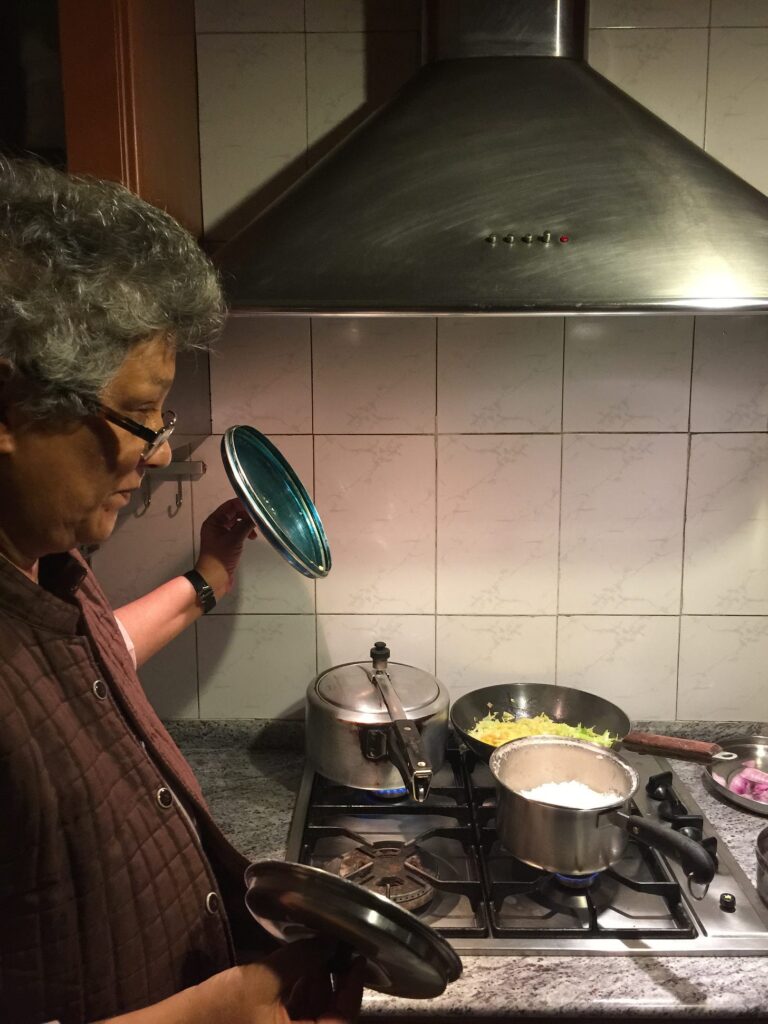
Years later, after multiple trips to India, I found myself in Punna’s kitchen in a high-rise flat in Bangalore, in the temperate southern state of Karnataka where she retired, learning how to cook dal. Not the kind of dal you find at Indian restaurants, which typically serve heavy dal makhani with huge dollops of butter. We cooked rajma dal, a north Indian dish made with kidney beans. The homemade version is healthy and uses only a little bit of oil, and far less heat. “Home food is light, not like in restaurants,” Punna said. “You can eat and eat and not gain kilos.”
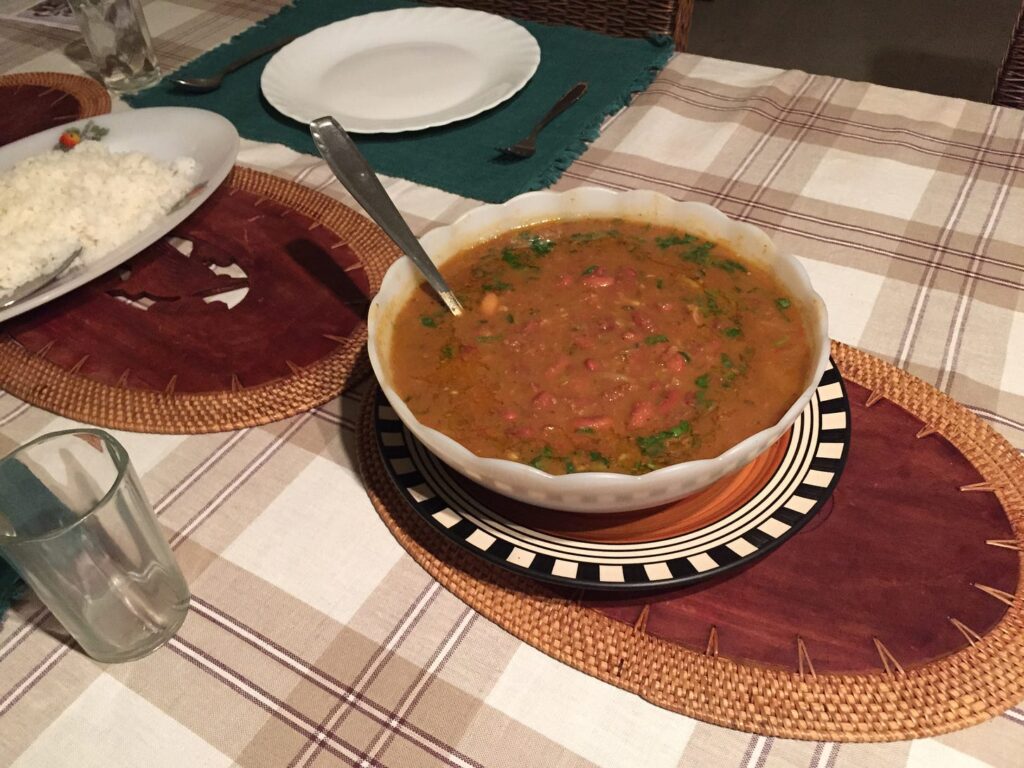
—> Behind the Paywall: Read the rest of Kristin’s story and Punna’s Rajma Dal recipe…
In Punna’s kitchen there were jars and bags of spices I’d never seen before, bright yellows and oranges and deep hues of red, a sunset trapped in her cupboard. Her refrigerator had raw chicken, lean and bony, not like the plump American chicken. Everything was smaller, more flavorful. Rice had a certain richness, even without butter.
“Slowly, so it doesn’t burn,” Punna said, stirring the onions. They were finally turning brown, melting with the tomatoes and spices: garam masala, turmeric, cumin and cardamom.
Jaidev eats like this when he is at home. He taught me to eat with my fingers, using the roti as a sort-of spoon. I was still awkward, clumsily folding the flat bread in half to scoop up the dal and rice. Punna made this way of eating look refined, like an art form. She delicately piled the rice and dal together with her fingertips, slowly bringing it to her lips.
“Spicy?” Punna asked, studying me from across the table. “Just right,” I said. And it was—the perfect blend of spices, with a hint of heat. It might have been my imagination, but I thought I saw a nearly imperceptible nod and flicker of a smile.
Years later, in our New York City kitchen, the tadka aromas fill the apartment, lingering long after the burner is turned off. Uma, our six-year-old daughter, likes mild dal, especially yellow dal with chicken curry. She’s more Minnesota Masala, like me: Now that I’m older, I can’t handle spice like I used to. Next time we visit her grandparents in India, Uma will be old enough to cook with Punna in her kitchen. Last year, Uma ate with her hands, greedily finishing plate after plate of homemade Indian food—including piping hot puri, Indian fried bread puffed up like pillows.
This Diwali—festival of lights—we plan to make Punna’s rajma dal and chicken curry, lighting diyas to invite the goddess Lakshmi into our home, bringing luck and prosperity in the new year. This hearty and satisfying meal is the perfect way to usher in November, cozy in sweaters and gathered around the stove. It’s just the three of us and Dad likes more spice, but it’s two against one and mild wins. I’ll let Uma add the spice, her small fingers pinching the chili pepper.
Punna’s Rajma Dal
“One usually cooks it according to individual taste—that means you reduce the amount of spices, taking into consideration how much the person eating it can take.”
Yield: Makes 4-5 servings (as part of a large meal)
ACTIVE TIME: 45 minutes TOTAL TIME: 2 1/2 hours
From your pantry: Salt (to taste)
Ingredients:
- 2 c. rajma dal (a.k.a. red kidney beans)
- 4 Tbsp vegetable oil or ghee (clarified butter)
- 3 red onions, around a three-inch radius (I am mentioning this as I have seen enormous onions in the U.S.)
- 2 tomatoes (diced)
- 1 Tbsp ginger paste
- 1 Tbsp garlic paste
- 1 Tbsp MDH brand rajma masala
- 1 tsp turmeric
- cilantro (handful)
- 2 or 3 green chilies (cut in half – optional)
- 1-2 pinches of red chili pepper (optional)
Shop Ingredients on Instacart
(Note from One Potato: We provide an Instacart link to help streamline your grocery shopping, but for some specialty ingredients, the online grocery shopping may not have the correct item. Please double-check your cart before checking out.)
Directions:
Prepare the Rajma:
- Wash the rajma and soak overnight; ensure the water is at least two inches over the rajma. Put it all in a pressure cooker along with the turmeric and salt. Add water until the cooker is at least half full. Turn down the heat once the cooker builds up pressure (around 5-10 minutes). Allow it to cook for a total of 90 minutes. The rajma should be soft; if not, add hot water and cook some more.
Prepare the Tadka – This is what we call tadka:
- Pour the oil into a wok and heat on medium-high until it shimmers; add the onion and cook until lightly brown. Add ginger, garlic, red chili pepper, and green chilies; cook for around five minutes, stirring so it doesn’t get stuck to the pan. Add diced tomatoes and masala, then cover and let simmer until it becomes a soft mash. Add a wee bit of water in-between if you feel it is sticking to the bottom.
Combine:
- Add the tadka to the rajma and let it cook for ten minutes. Grind a bit of the rajma with a spoon against the wok so that it thickens, but leave most of the beans intact. Add cilantro.
Enjoy!
About:
Kristin Vuković has written articles about Croatia for more than a decade, for The New York Times, BBC Travel, Travel + Leisure, Virtuoso, Hemispheres, Robb Report, AFAR, Fodor’s, and Public Books, among others. She has received numerous awards for her travel writing. Kristin holds a BA in literature and writing and an MFA in nonfiction writing from Columbia University. She resides in New York City with her husband and daughter.
Kristin Vuković’s debut novel, THE CHEESEMAKER’S DAUGHTER, was published on August 6, 2024. “A literary page-turner with unforgettable heart” (bestselling author Caroline Leavitt), THE CHEESEMAKER’S DAUGHTER beautifully reveals “a woman who blossoms into the person she was always meant to be” (bestselling author Jill Santopolo). It might also be “the first novel that inspires cheese pairings” (Minnesota Star Tribune).


