This post contains affiliate links. If you buy through them, One Potato may earn a small commission at no extra cost to you.
Small Bites: Kids Cook Solo sounded too good to be true until we read how it works: kids 8-years-old and up move through 14 kitchen skills on their own, and your job is about five minutes a lesson, when they teach you the safety steps before you give the green light. No knives, 12 months of access, and Katie will send a sample lesson if you want to test it first. 👉 Request a sample lesson
Books, Books, Books – by Shannon Sarna
Modern Jewish Baker: Challah, Babka, Bagels & More [Bookshop, Amazon]
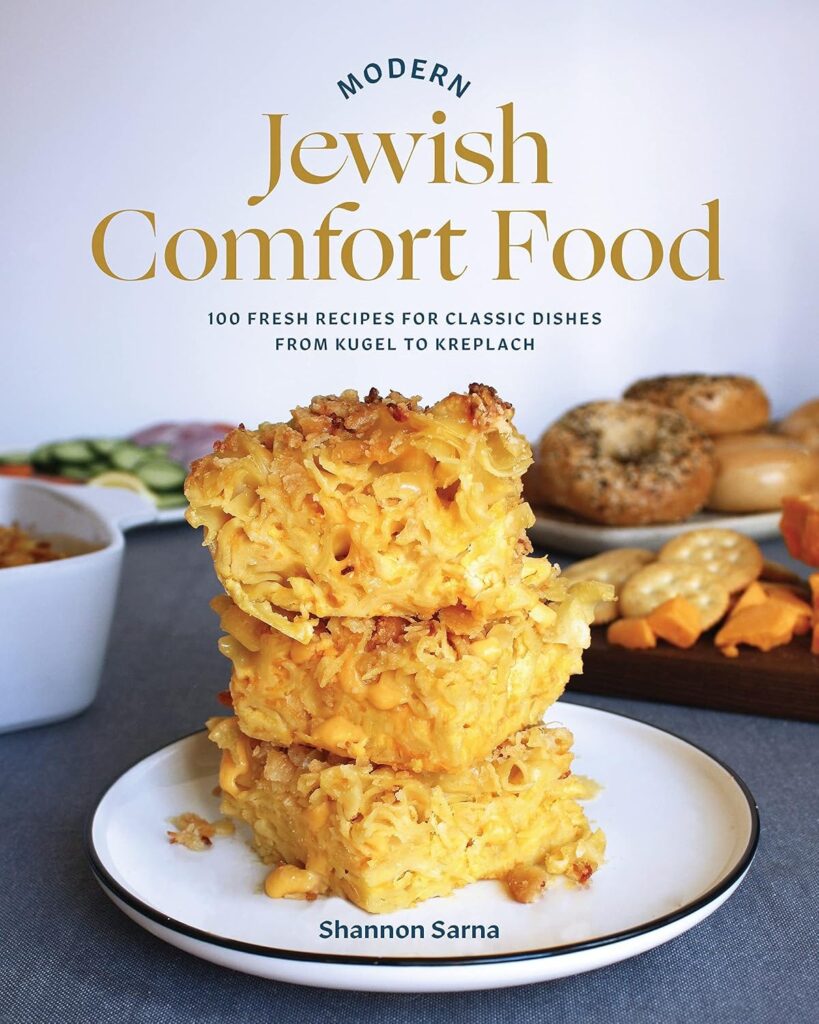
Modern Jewish Comfort Food: 100 Fresh Recipes for Classic Dishes from Kugel to Kreplach [Bookshop, Amazon]

Food Is Love, and Other Things Shannon Sarna Knows for Sure
Shannon Sarna didn’t grow up wanting any of this *gestures broadly at chaotic family life*. She wanted to be a Broadway star. She wasn’t domestic, wasn’t interested in cooking, wasn’t planning on having kids. Then her mom passed away when she was sixteen, and she found herself feeding her six-year-old and thirteen-year-old siblings and calling a friend’s mother to ask how to boil a hot dog.
Almost thirty years later, she’s a cookbook author, the founding editor of The Nosher, and Chief of Staff to a six-time James Beard-nominated chef. From professional kitchens to cooking for her family at home, Shannon has thought hard about how she and her husband talk about food in front of our kids. In her house, there’s no such thing as good or bad food, and you cannot say the word fat. She’s a butter mom and an Entenmann’s mom, she cooks dinner five nights a week. She wants her kids to learn to feed themselves and each other.
We talked about learning to cook out of necessity, raising Jewish kids with an Italian Christmas Eve (and the Christmas cookies she bakes every year because they were her mother’s special thing, and her kids will never meet their grandmother any other way), why she’d tell a parent intimidated by baking to start with pita instead of challah, and the one kitchen skill she thinks matters more than any recipe.
A special note from our friends at Raising Healthy Families:
Teach the Skill, Not the Recipe
Your kid asks to help cook at 5:40pm, which is the worst possible moment to teach anybody anything, so you say “not tonight” and finish dinner alone. Then you feel a little bad about it. The trouble was never that we don’t want our kids in the kitchen, it’s that the asking never comes at a teachable hour. Katie Kimball’s Kids Cook Real Food eCourse moves the teaching off your plate entirely: the lessons happen on video, at whatever time your family actually has.
The course runs across three skill levels so kids join where they are and grow into the rest, and the focus stays on skills rather than recipes, which is why a kid who learns to hold a knife properly can go on to handle half the produce drawer without a new set of instructions. VIP access never expires, so it carries a family from a four-year-old on a step stool to a teenager making dinner. The free knife skills class is a good way to see whether the tone works for your kid before you spend anything. 👉 Start with the free knife skills class
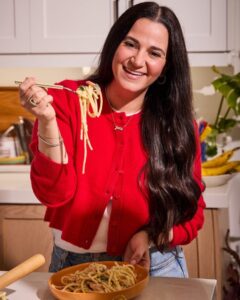
A Conversation with Shannon Sarna, cookbook writer & founding editor of The Nosher
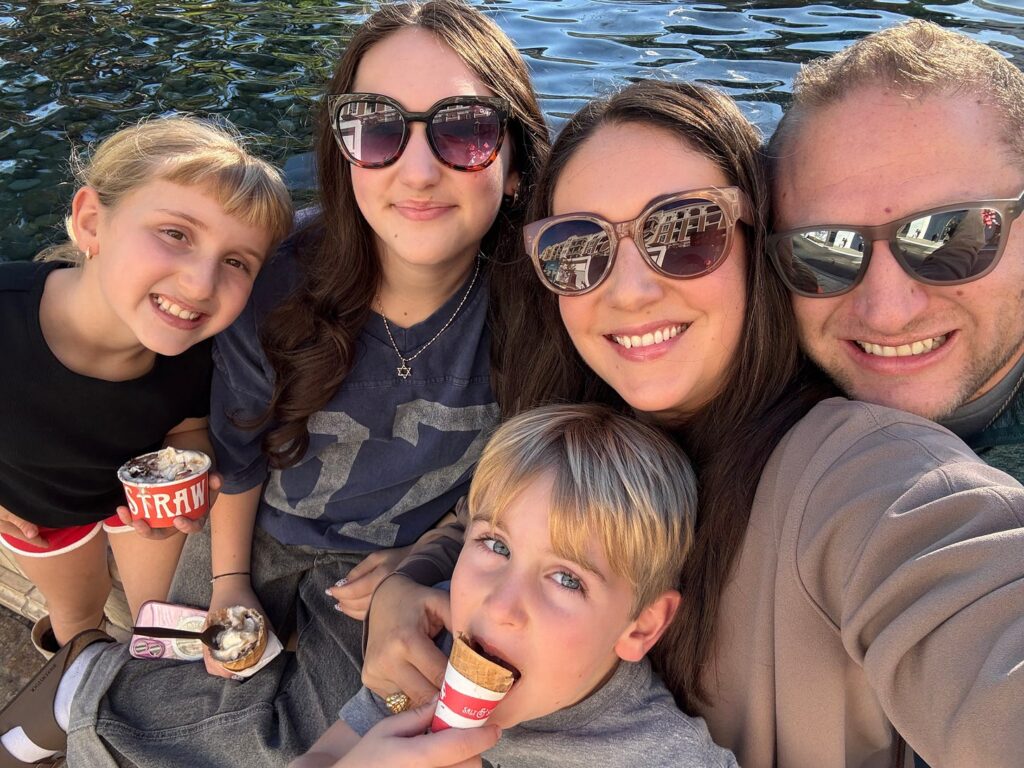
Introduce Yourself: I’m Shannon Sarna. I’m a cookbook author and a mom; my three kids are 14, 10, and almost seven.
I spent thirteen years as the founding editor of The Nosher, which was a real joy. Now my official title is Chief of Staff to Chef Dan Richer at Razza, a six-time James Beard-nominated restaurant in Jersey City.
You taught yourself to cook and bake at sixteen, after your mom died, partly to feed your younger siblings. How did becoming the family cook shape your relationship to food?
I can’t emphasize enough what a shift it was. I grew up in an Italian and Jewish family where food was central, and I loved to eat, but I never cooked. I was going to be on Broadway and I cared about nothing else. Nothing domestic was on my radar.
Then suddenly I had a six-year-old and a thirteen-year-old to feed for long stretches, and I was calling my friend Andrea’s mom asking how to make a hot dog. I didn’t know how to boil one. Becoming a cook came incrementally to me, over almost thirty years of trial and error. I’ve been thinking about that a lot lately — that I started knowing almost nothing, and now I get to guide other people. That’s kind of crazy, but it’s also a privilege.

Does that make you want to be sure your own kids leave home knowing how to feed themselves?
A thousand percent. As someone who’s been in therapy most of my adult life, there’s pretty much nothing about my mom’s death and helping raise my siblings that didn’t shape how I live in good ways and crazy ways, both. But it’s really important to me that my kids have basic skills and know how to take care of one another.
I was away recently helping a friend, and my ten-year-old made dinner for my seven-year-old. Not because my husband wasn’t home, she just said, ‘oh, I’m warming up rice for myself, Jude wants some too, I’ll do that’. My fourteen-year-old cooks for herself all the time, and sometimes for all of us.
You’ve said that when family or friends come to visit, the first question is always: “what can I feed you?” Does that caring-through-food instinct show up with your own kids?
My father-in-law would lovingly, ruthlessly make fun of me for it, because I’m always asking, “are you hungry? did you eat?”. For so many cultures, food is love; it’s universal. I connect deeply with other ethnic moms because that’s what we do.
I fold my kids into meal planning, not just so they eat, but because it engages them. They’ll say, I read about this food, can we try it? My oldest is really into Korean culture. She read about tteokbokki (spicy Korean rice cakes) years ago and desperately wanted it. I found a restaurant here, because New Jersey is the most diverse state, you can find anything. And it turns out Korean food is one of the few things the whole family will eat!
Your mom never talked about dieting; you mentioned she might eat Entenmann’s every morning, but there was always fresh fruit, always balance. How much of how you feed your family comes from her?
A lot. How we talk about food and bodies is top of mind for me every single day. I grew up performing, I heard comments about my own body, and now I have two daughters, one of them also a performer. So I choose my words carefully. There’s no such thing as good or bad food in my house; that’s where you start passing down toxic ideas. We don’t use the word fat. You cannot say it in my house, and I have no tolerance for it.
I’m passionate about farming and local food, but I’m also a butter mom, an Entenmann’s mom. There’s always an abundance of fresh food, and there’s also a cookie. I cook dinner five nights a week and pack lunch most days, and there are cheese doodles in the lunch next to the berries and the yogurt. I want them to learn to navigate that themselves.
When I talk about working out, I say I want to be a strong, healthy mom for you. Never that I want to lose weight. That’s off the table. There’s joy in food, like art. Peach season is my middle daughter’s favorite fruit season. My oldest loves mangoes. That joy should be there, without shame.

You grew up with rugelach next to your mom’s Christmas cookies. How do you think about passing on that blended identity to your kids? A lot of our readers have mixed heritages.
Statistically, most American Jews are more like me than like my husband, who comes from a thousand generations of Ashkenazi Jews. At The Nosher, it was an overt goal to help other Jews see their identities reflected in diverse foods. Jewish food isn’t just pastrami and matzo ball soup. There are Puerto Rican Jews, Chinese Jews, Italian Jews. That range is beautiful.
Our family identifies very Jewishly: we belong to a conservative synagogue, my kids go to Jewish day school, Shabbat is essential. But I come from a more diverse background, and it took me a little while to feel comfortable bringing those traditions into my family. Not sharing them would have denied my kids, and denied me a connection to my mom.
So we celebrate Christmas in a cultural, American way. We do cookies and give them to the teachers, we see the Nutcracker, we have a Christmas Eve tradition that was my mom’s Italian one. My kids know what the holiday celebrates, and it’s important to me that they understand. But I liken it to celebrating Diwali with our Indian friends, or eating dumplings for Chinese New Year — it’s about embracing the diversity around us. My kids don’t get to have a relationship with their grandmother, so these are little snippets of her they can have.
Challah was the first thing you taught yourself to master. For a parent who finds baking bread intimidating, is challah a good place to start?
Honestly, I wouldn’t tell people to start with challah; it’s just where I started, and it’s more complicated than people think. Baking bread is amazing, and once you see how easy it can be, you fold it into your week. But I’d start with pita. It’s four ingredients, a short rise, easy to do by hand, and it doesn’t need the gluten development challah does. Or a no-knead loaf you mix, stick in the fridge, and throw in the oven. You pull it out hot and it gets devoured. That’s the perfect entry point.
I suggest pita partly because pita in the US kind of sucks; what you make at home is infinitely better. Then you can work up to challah.
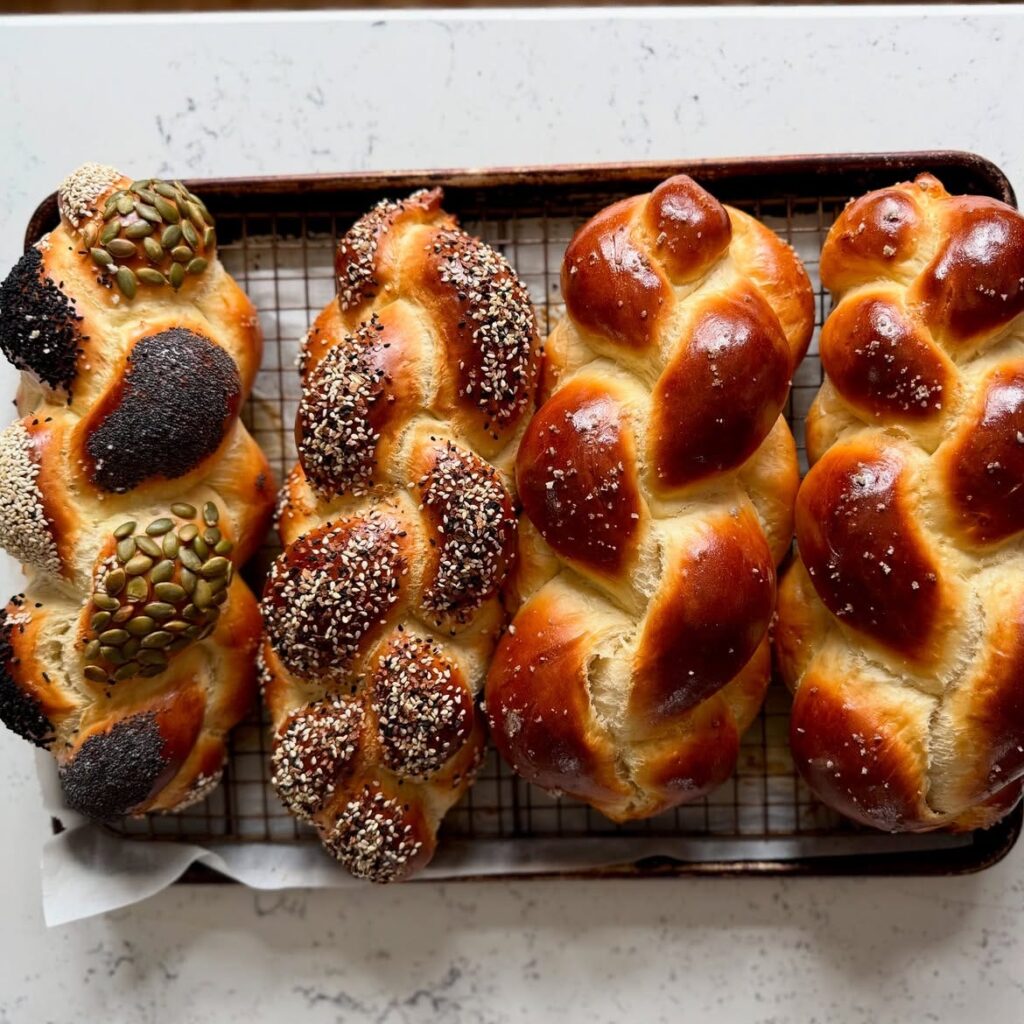
Your daughter used to think challah should always have M&Ms or sprinkles. How do you keep tradition fun without losing it?
What I consider traditional might not feel that way to another family, and I say that with respect — but I also don’t care. Sometimes people think engaging with their Jewishness has to look a particular way to be real. They’ll say, I’m not really Jewish like that, or Shabbat doesn’t count unless it’s homemade challah and chicken soup.
But a Shabbat meal can be a store-bought challah. Babka doesn’t have to be chocolate. If a kid makes unicorn challah, they’re still making challah. Years ago some chef made bacon-wrapped matzo balls and everyone got mad, but that was still some form of their Jewish identity. Who am I to say it’s invalid? You bring you. You make it your own. [Find Shannon’s foolproof challah recipe right here on The Kitchn.]
What do you most hope your three kids carry from your kitchen?
I hope they won’t always roll their eyes when I offer to tell them the history of bagels. Mostly I want them to feel proud. Proud of being Jewish in whatever way that means to them, and proud of their dual heritage.
And I want them to understand the world through food: that food tells everyone’s stories, and that they’re all interconnected. They love Chinese food, they love pasta. I want them to understand how one influenced the other. Jewish food tells the story of our people. We eat noodles with cottage cheese; here’s why, here’s where it came from on both sides of our family, here’s how far our families have come. It’s a sense of pride, but also an understanding of how we fit into the rest of the world.
If a parent wants to share their heritage through food but doesn’t want it to feel stressful, what’s the easiest way in?
Pick the one food that mattered to you and focus on that, then buy the rest. If Shabbat meant a roast chicken, make the roast chicken and outsource everything else so it’s doable. If it’s baking, bring in a hack, especially when kids are young, because baking with kids sounds fun and is actually messy, and they don’t listen, and it doesn’t come out well. It’s more enticing in theory than in practice.
And it doesn’t have to be cooking at all. It can be going to the market together, picking out the special pickles, setting the table, making place cards, talking to the butcher. Think of Charlotte on Sex and the City converting and preparing Shabbat dinner: the homemade challah, the brisket, the perfect apron, and then the whole thing imploding. If that’s your vision of how to do Jewish, you’ll drown. Pick one thing and buy or simplify the rest. The meaningful part is the time together, not the quality or perfectionism of the food.
Is there one cooking skill you think every home cook should know?
The best skill you can have is figuring out what to do with what you already have. Not every dinner needs to be: I picked this recipe and I’m making it. Sometimes it’s: I have corn and a can of beans and some pasta, so I’ll make pasta and a salad that don’t really go together, and it doesn’t matter. Or we’ll have eggs and toast and fruit and yogurt, and that’s a full meal.
Being able to look in your pantry and fridge and freezer and know you probably already have dinner tonight, without running to the store, that’s the skill. I know it scares people whose brains don’t work that way, who feel they have to follow a recipe. But nobody ever complained about a bowl of spaghetti with butter and a salad on the side. That’s a good dinner. Period.