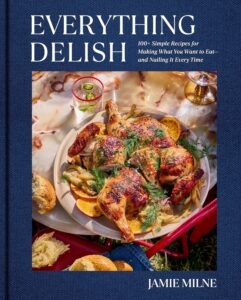
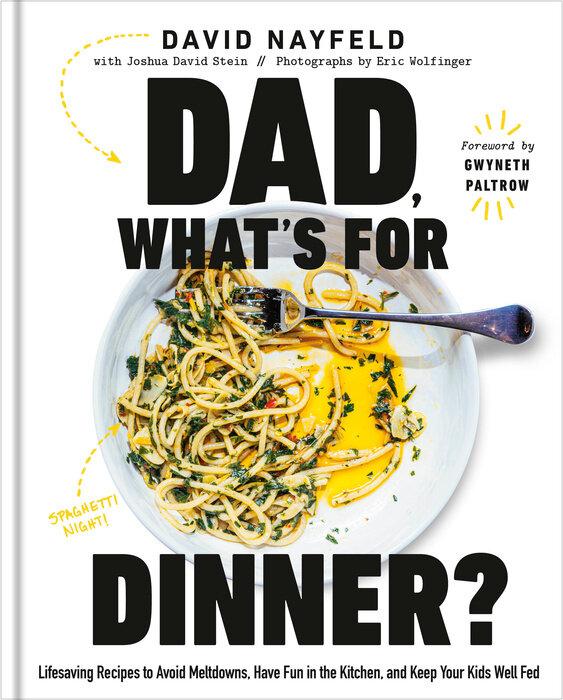
Small Bites: Get your copy of David Nayfeld’s cookbook: Dad, What’s for Dinner? [Bookshop, Amazon]
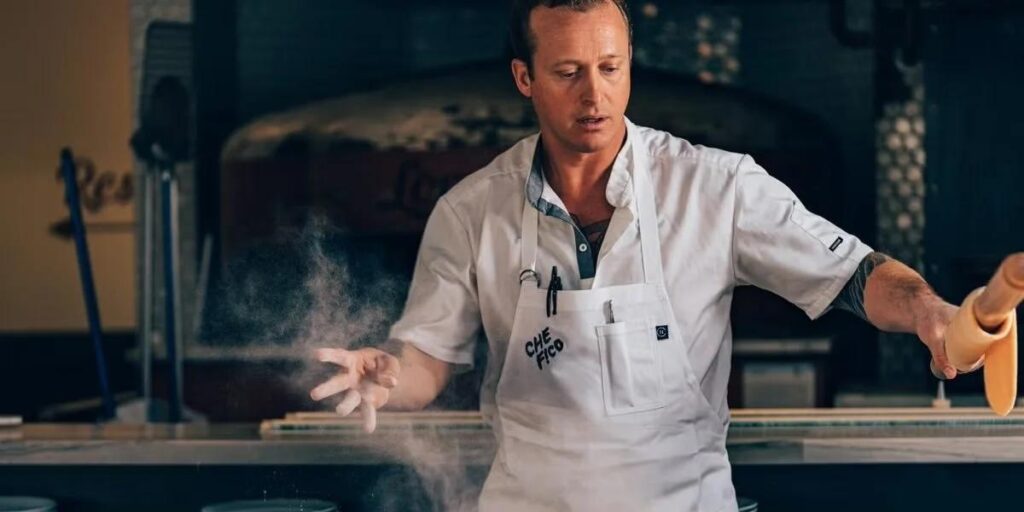
The Recipe for Life Is Togetherness: David Nayfeld on Cooking with His Kids
This fall, David Nayfeld and his seven-year-old daughter, Helena, made a round challah for Rosh Hashanah. They made the dough together and took it through every step. Then, while they were rolling out the long ropes for the braid, Helena started playing with the dough, and David got short with her. “No, no, that’s not what we’re doing.”
Then he stopped and asked himself what he wanted her to remember. The most perfect challah she’d ever had, or the day she learned to make it with her dad? He apologized. He told her this mattered to him, and that he shouldn’t be impatient, because they were supposed to be having fun.
Like many of our One Potato interview guests, David is a chef. He runs Back Home Hospitality, the San Francisco restaurant group behind Che Fico, and he wrote the cookbook Dad, What’s for Dinner? [Bookshop, Amazon] His parents left Minsk in 1979 and both had to work. He was a picky kid who didn’t want to eat what everyone else was eating, so he learned to cook for himself. Today he has three kids at home: Helena, a baby daughter, and a 16-year-old bonus son.
We talked about how his mom took him to farmers’ markets but never really taught him to cook, and the fried chicken he made at ~eight years old that came out raw. He explains how his cookbook changed while he was going through a breakup and a custody dispute, the three stages he uses to decide what a kid can do in the kitchen, and a specific example of when his family cooked dinner on a busy Monday night when ordering in would have been easier.
His advice for cooking with kids is simple enough to try tonight: make a plan, clean as you go, and let them make a mess. He says the mess is good for them.
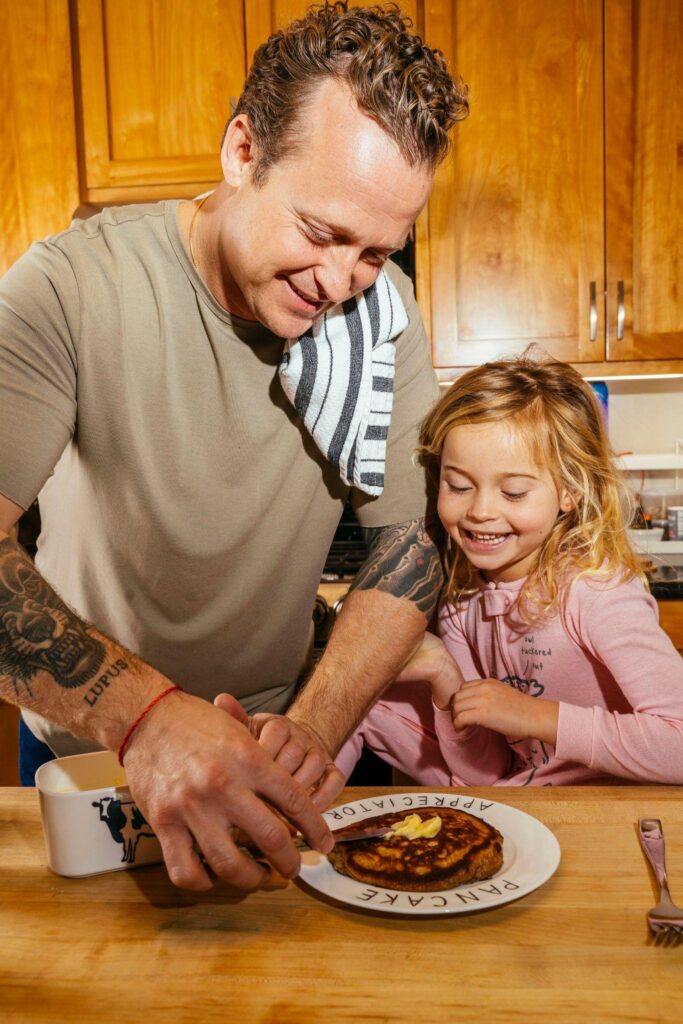
Photo Credit: David Nayfeld
Introduce yourself.
My name is David Nayfeld. I’m the chef and co-owner of Back Home Hospitality, where we own and operate a number of restaurants and bars. I have two daughters and a bonus son, and I’m now also a cookbook author. The book is called Dad, What’s for Dinner?
Our son is 16. My daughter Helena is seven, and she turns eight in January. And my newest addition, my younger daughter, is nine months old.
Did you learn to cook from your mom?
I almost feel bad saying this every time, but I didn’t really learn anything about cooking from my mom, because my mom was putting food on the table. I mean that in the economic sense. When she and my dad got to this country, it was very clear that for us to survive, they both had to go out and earn an income. She was very educated. She went to music school in Belarus, then chiropractic school here. Cooking just wasn’t her focus.
But she taught me something that might be the most important part of my identity as a chef, which is shopping at the farmers market. From the earliest age I can remember, my mom sought out little one-block farmers’ markets at Jack London Square or other places in the East Bay. When some American friends lent us their cabin in Sonora, we’d always stop at the farm stands on the drive up. In a lot of ways, my identity as a chef comes from how I shop. That’s where my mom’s influence comes in.
So how did you start cooking?
I was a very picky eater, and I was very rebellious. I didn’t like being told what I had to eat or what I had to do. So I was told very early: fine. If you don’t want to eat what everybody else is eating, you have to learn how to cook something for yourself.
Then my aunt started dating this American guy. It was the first time I’d ever seen a man cook, and the first time I’d seen fried chicken made in a house. I associated fried chicken with KFC. I didn’t even know it could be done at home. I was maybe seven, eight, or nine, and I watched him and thought, what’s the problem? I can do that. I tried to recreate it a couple of weeks later.
The man who lent us the cabin cooked too. At their house I had traditional American food for the first time, like grilled steak and glazed vegetables. I liked it a lot more than Russian food, with all the salads laden with mayonnaise. They’d open a bottle of wine every night and entertain, and I thought, oh, this is cool. I like this version of dinner.
How did that first fried chicken turn out?
It was definitely still raw. My mom just threw it in the oven for everybody, so it didn’t kill anyone.
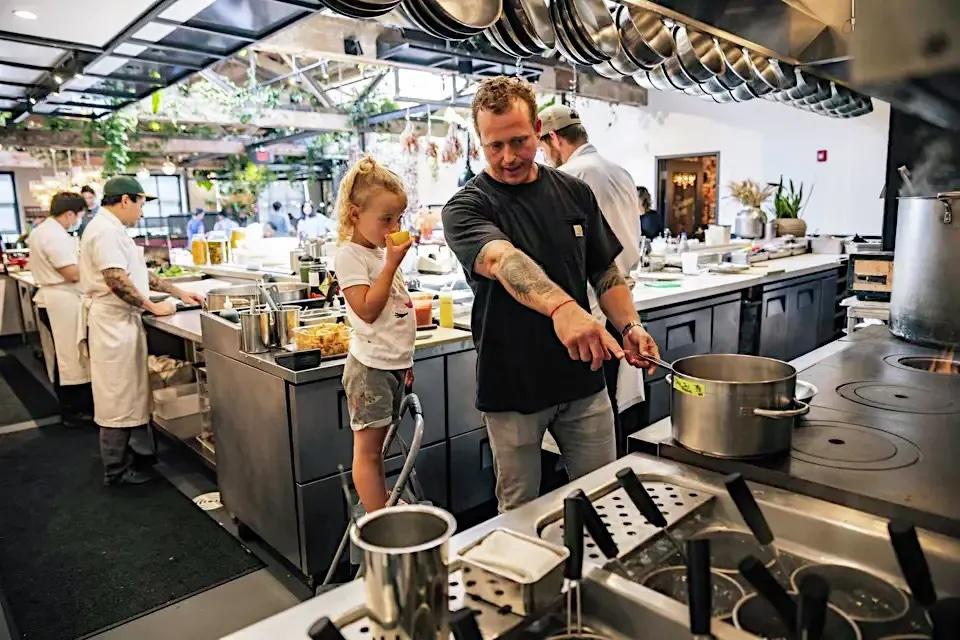
When Helena tries something in the kitchen and it doesn’t go right, how do you react?
I’m not as gracious as my mom. Whatever she lacks in cooking, she makes up for twentyfold by being an absolute saint of a person. She has endless love and patience for her children and grandchildren. I’m not a very patient person, and I have the added problem that this is what I do for a living.
We just had this happen. We were making a round challah for Rosh Hashanah, and I wanted to show Helena how to do it. We’d made the dough and gone through the whole process. Then, when we were rolling the long ropes for the braid, she started messing around with the dough, and it was going to ruin it. I got really short with her, telling her over and over again that she was doing it wrong.
Then I had to stop myself and ask, what memory are you trying to give her? That this was the most perfect challah she’s ever had in her life? Or that we had this experience together and she learned how to make challah with me? I wasn’t proud of how I reacted. So I told her, I’m really sorry I reacted that way. This is really important to me, and I want to share it with you. But I shouldn’t be so impatient, because we’re supposed to be having fun.
I constantly have a voice in my head about messes. When we’re doing this, a mess is actually good. There’s a purpose to kids moving things around, touching things, not having to be perfect.
And I’m a reformed line cook. Mess is bad. Knife not perfectly wiped off, bad. Towel not perfectly folded by your side, bad. More than one thing on your cutting board, bad. When I’m cooking with my kids, I’ve had to completely rework that wiring and tell myself all of this is in bounds. And not only is it in bounds, it’s additive.
You’ve mentioned draniki as a dish from your childhood. Do you make them for your kids?
Draniki are Belarus’s version of the potato pancake, and often they’re stuffed with something, like ground chicken. What makes them unique is that instead of shredding the potatoes, you put them through a meat grinder. You get almost a potato batter, and it’s wetter. So you end up with more of a true pancake than the crispy latkes a lot of people make for Hanukkah, which I love too.
They’re special to me because they’re nostalgic. My mom’s husband taught me how to make them. He’s from Belarus too. His family immigrated to Israel and mine came to America, and he and my mom met later in life. Now he makes them for Helena a lot, and she loves them.
Your book changed direction while you were separating from your daughter’s mother, and in the middle of a custody dispute. What did you have to rewrite?
The big aha moment was that I needed to rewrite the procedures. It wasn’t so much about the dishes. It was about what’s important here, and what’s important is time spent together. I realized I’d stumbled on the real thesis of the book. It’s less about “here’s a great recipe” and more about, “what’s the recipe for life.” And the recipe for life is togetherness.
It’s quality time. It’s taking the phones and putting them somewhere else when we sit down together. It’s not the perfect challah. It’s the memory of making challah together.
And I knew that if I was having my own challenge with that, as a professional, everyone else would find it impossible. What am I supposed to have this two-year-old do that’s not going to create a complete mess? Or this 15-year-old who’s telling me to do it myself? How do I get them involved?
I don’t want to eat from the kids’ menu. It’s not buttered noodles with cheese at my house. These kids need protein and vegetables in their bodies. So I went back to every recipe I’d written and asked, where’s the opportunity here for the kids?
How do you decide what a kid can handle in the kitchen?
I built a kind of rubric with three stages. Stage one is, nothing bad can happen. Pick an herb, whatever. Stage two has an element of risk, but nobody’s going to get seriously hurt. Stage three is, serious risk. We need trust, maturity, height, stability. There are certain 20-year-olds I wouldn’t trust frying chicken by themselves.
Then you apply it to your own kids. Maybe little Johnny is 10, but he’s very hyperactive and doesn’t really pay attention, so we keep him away from anything dangerous. Maybe little Wally is 10 and very mindful, and he can use a sharp knife because we’ve worked on it. In each recipe, I show what’s a good stage one, stage two, and stage three job.
Photo Credit: David Nayfeld
TV dads usually can’t do anything in the kitchen. What do you see in the dads around you?
I don’t know if it’s the group of men I spend time with or the fact that it’s 2026. Probably a bit of both. Stereotypes come from somewhere. But in my circle, I see guys who are up in the morning packing lunches, making it to work, helping clean the house, and supporting their wives in their careers. My older brother is probably the biggest example. He runs his own company, drives the kids to school and to water polo practice, and coaches the soccer team. And I grew up with two parents who were both breadwinners. So honestly, the trope became irritating to me.
To me, the meaning of life is family. We were just in Tennessee because my fiancée has a really great job and needed to go to an off-site, and the baby had to come. We could have hired someone. Instead I told my team I’d be gone for the week, because I was on childcare. That was my job. The baby could count on me, I did the routine, and it felt really good. It was important to show my fiancée that I understand how important her job is, too.
If we want men to be caretakers, and women to be breadwinners, we have to give everyone room to do that. And give credit when it’s happening.
Lots of parents want to cook more but don’t. What’s usually missing?
Probably the same thing that’s missing when people know they should work out and don’t. Time. It’s not convenient.
There’s no not-harsh way of saying this: the life you live is the life you’ve allowed to exist. Mondays and Tuesdays are really busy in our house. We’ve got soccer, fencing, music class, travel wrestling, a baby, two careers, and kids going to school on different sides of the Bay Area.
This past Monday would have been a really easy day to order food. And I’m not saying we never order food. There are times my fiancée looks at me and says, bro, today’s the day we order food. We’re not going to go down with the ship on this ideal. But we’d been doing it a little too much. I need the kids to see a consistent pattern. Cooking at home is the default; ordering food is a special thing.
So in the middle of my meetings, I ran to the store. There’s a chicken parm I make that isn’t fried or breaded. You sauté a chicken cutlet so it’s not quite cooked through, put sauce over it with some fresh mozzarella and Parmesan, and bake it. Everyone in the family loves it. Monday I made it with leftover tomato sauce, big chunks of zucchini, and some kale we grow outside.
My big non-negotiable is that we eat at the table together, with no phones. We’re a blended family, so I want there to be time, multiple times a week, when we stop and engage as a family.
If you want the secret, it’s planning. That’s the line cook in me, or maybe more the sous chef. If you don’t know what you’re cooking, don’t have your stuff ready, and don’t prep little parts throughout the day, it all falls apart. I also clean as I go, so at the end of the night there isn’t a huge pile of dishes. Have a plan, clean as you go, and have the willpower to say, “we’re doing this.”
What’s one cooking skill every home cook should practice?
It’s a boring one: knife skills. Knife skills are what make something a 10-minute job instead of a 40-minute job. If cooking always feels like it takes forever, and it’s hard and awkward, that’s muscle memory.
So keep your knife sharp. Learn to sharpen it, or send it out to the butcher shop or the hardware store every quarter. Then cut onions, carrots, celery, zucchini, whatever, enough that you start moving quickly. That’s going to pay the biggest dividends. [David also shared 5 Tips from a Chef on his Substack!]
Follow David on Instagram @davidnayfeld
& Don’t forget to follow US on IG @onepotatobox ❤️