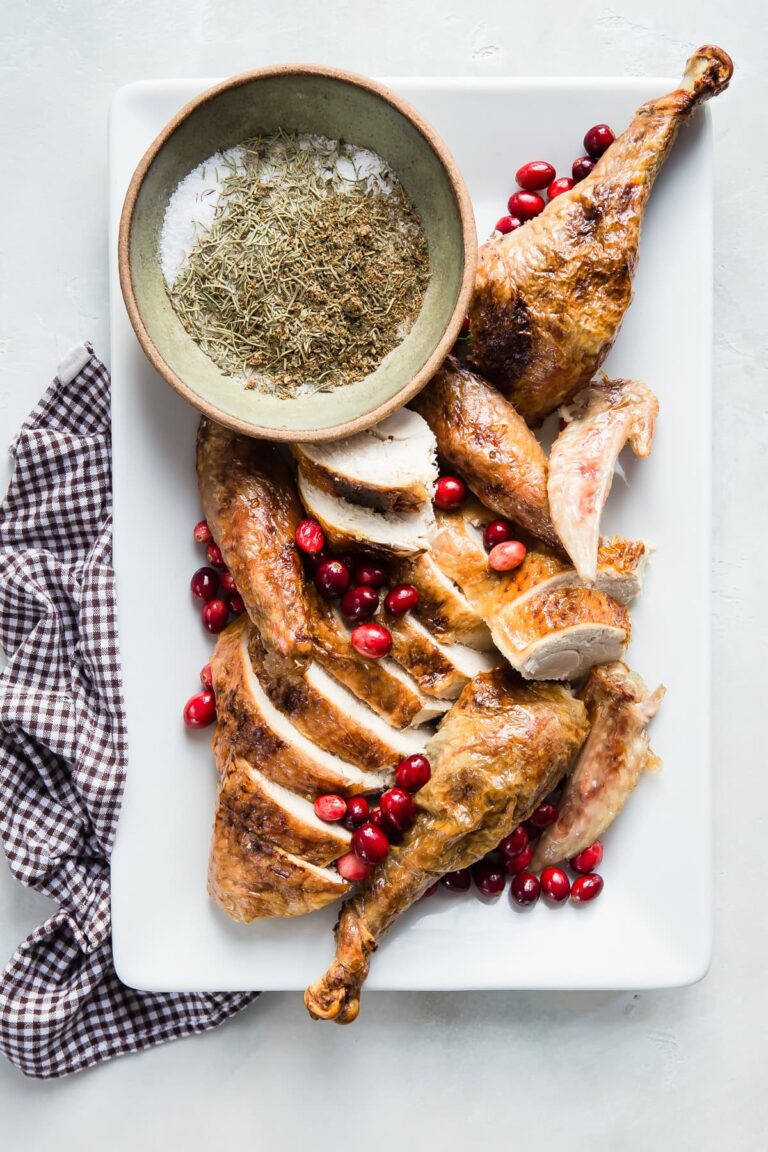
Ingredients
- 1 whole turkey, 12–14 pounds
- 3 tablespoons kosher salt
- 1 tablespoon dried sage
- 1 tablespoon dried thyme
- 1 tablespoon dried rosemary
- 2 cups turkey or chicken stock
Instructions
1. Prep the Turkey
Remove the giblets and save them if you’re making homemade gravy. Pat the turkey very dry with paper towels.
2. Make the Herb Brine
In a small bowl, whisk together the kosher salt, sage, thyme, and rosemary.
3. Season Well
Rub the herb and salt mixture all over the turkey, including inside the cavity. Make sure the seasoning is spread evenly over the skin.
4. Let It Brine
Place the turkey on a rack set over a large plate or baking sheet. Refrigerate it uncovered for 24–48 hours. This gives the seasoning time to work its way into the meat while helping the skin dry out for better browning.
5. Bring It Toward Room Temperature
Remove the turkey from the refrigerator 1–2 hours before cooking.
Preheat the oven to 450°F.
6. Start Hot
Tuck the wings behind the neck so they don’t burn. Place the turkey breast-side up on a roasting rack and pour 2 cups of turkey or chicken stock into the roasting pan.
Roast at 450°F for 30 minutes.
7. Finish at 350°F
Reduce the oven temperature to 350°F. Rotate the roasting pan 90 degrees to help the turkey cook evenly.
Continue roasting for about 2 hours to 2 hours 15 minutes, basting every 30 minutes. If the breast starts browning too quickly, loosely cover it with foil.
8. Check the Temperature
Insert a meat thermometer into the deepest part of the thigh, being careful not to touch the bone. The turkey is ready when it reaches 165–170°F internally.
9. Rest Before Slicing
Transfer the turkey to a cutting board and let it rest for 30 minutes before carving. This gives the juices time to redistribute so the meat stays moist.
Then slice, serve, and enjoy.
Notes
- Plan ahead: The turkey needs 24–48 hours in the refrigerator for the dry brine, so start early.
- Keep it contained: Place the turkey on a baking sheet or large tray while it brines to catch any drips.
- Give it space: Keep the raw turkey on its own shelf in the refrigerator to avoid contact with other foods.
- Don’t skip the thermometer: Cooking time can vary, so temperature is the best way to check for doneness.
- Save the giblets: They can be used to make a flavorful turkey gravy.
- Keep an eye on the breast: If it gets too dark before the turkey is finished, cover it loosely with foil.
- Prep Time: 20 minutes
- Dry brine: 24 hours
- Cook Time: 2 hours 30 minutes
- Category: Main Dish
- Cuisine: American
